The Dream Team
A pixel-art animation synced to music through a custom browser-based analysis tool
Two unfinished figures complete one another.
The music is the Dream Team by Fievel Is Glauque, a Brussels and New York duo: pianist Zach Phillips and vocalist Ma Clément. Their 2021 debut God’s Trashmen Sent to Right the Mess was recorded live to mono cassette across five cities with a different assembly of musicians on each track. The Dream Team is ninety seconds long.
The figures come from the Scan the World archive, hosted by MyMiniFactory.
A heavy wooden figure from Mangareva, one of the Gambier Islands in the eastern Pacific. Thought to represent Rongo, god of agriculture, rain, and the breadfruit harvest. Few such figures survived the island’s conversion to Christianity in the 1830s. This one is missing its hands.
After a work by Alexander Burganov (b. 1935), National Artist of Russia, member of the Russian Academy of Fine Arts. His sculpture is built from body fragments.
Rongo is an abstraction made into a form. An idea of harvest and rain given weight and limbs. Burganov’s female is the reverse: a real form used to ask an abstract question about when a person is fully formed. One missing hands by historical accident. One missing parts on purpose.
The song lyric puts it plainly: doubling all partial so completely.
The visual language wrapping them is borrowed from Nathalie Du Pasquier’s Manifesto series, five posters translating her orthogonal graphic language into figure studies. Three texture compositions drawn from the series are used, one per figure, one for the background. They were arranged to keep the figures graphically distinct when the 3D forms get close and begin to merge in frame. Order doing the work of clarity inside a piece committed to density.
Three pipelines, one composition
The animation was built across three parallel workflows that converged in a final After Effects composition.
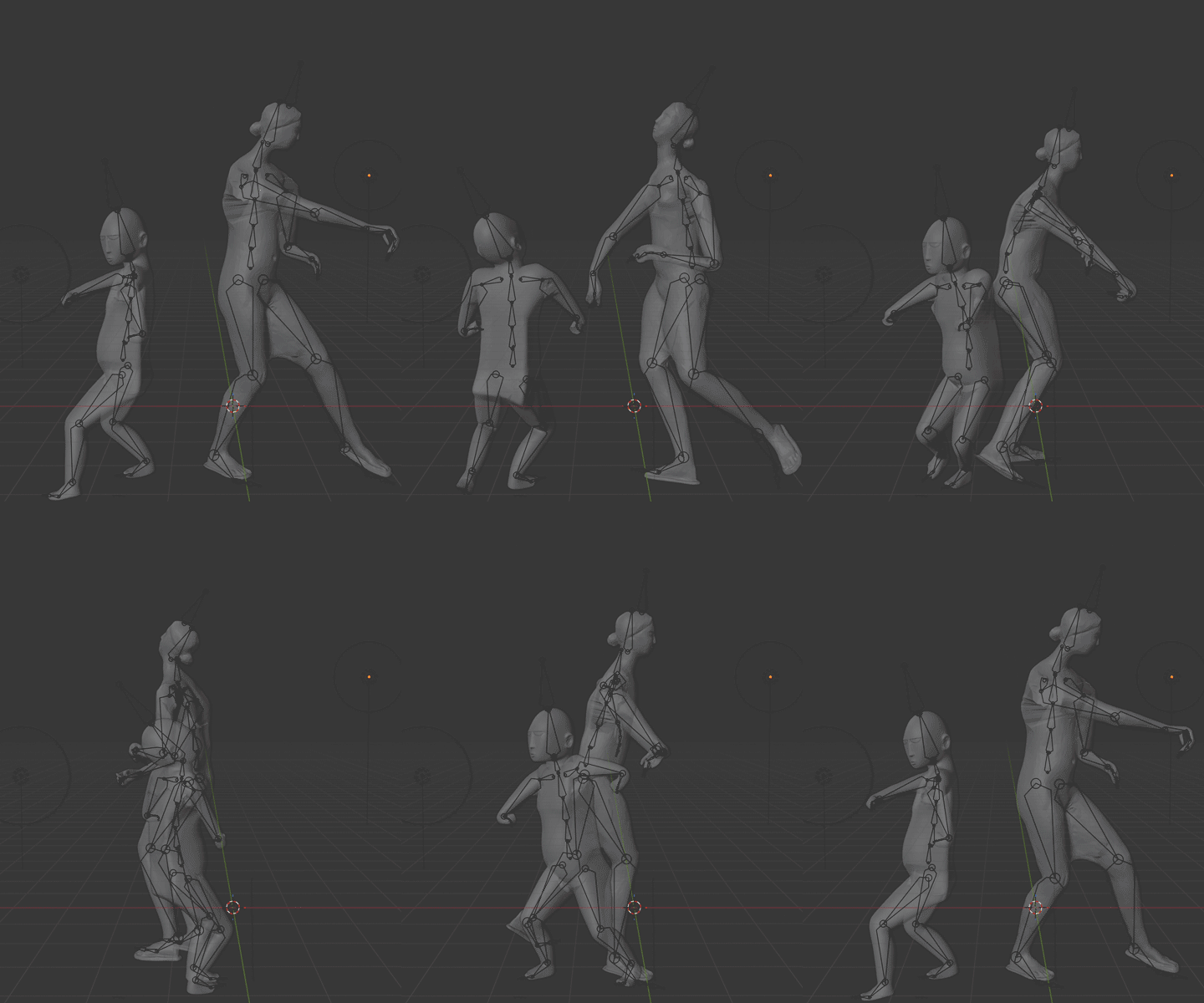
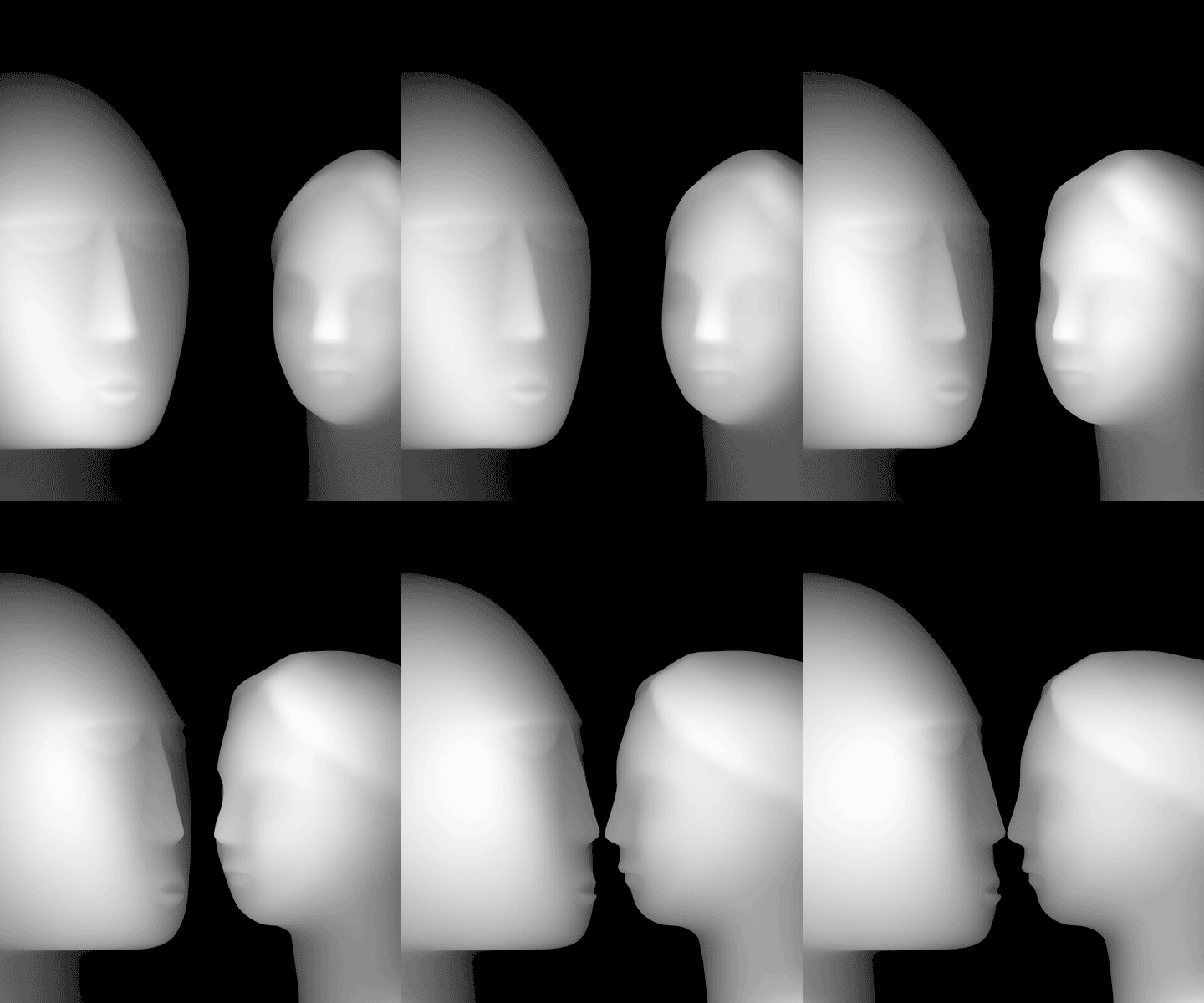
STL files from the Scan the World archive were geometry-prepped in Blender for Mixamo auto-rigging. Full dance animations were applied and exported as FBX. The dances were chosen on two criteria: universality and careless joy. Salsa, rhumba, the twist. Dances anyone can do. Back in Blender they were adjusted to sit on the tempo of the track. Two render passes per figure: a grayscale perspective render and an orthographic render. The perspective render became the topographic source for pixel shading. The orthographic render was processed into a depth map and used to displace background elements in the composition, its effect growing over the duration of the piece.
A custom audio analysis tool was built for this project. The track was uploaded, analyzed for onset events, structural sections, and tempo. The results exported as a JSX script that, when run in After Effects, placed five null layers in the composition, each carrying a different category of marker. These layers served as a snap grid throughout the edit.
The Blender footage was keyed using the Extract effect. The resulting mattes masked the artwork layers beneath them. The artwork layers were 200×200 px precompositions tiled across the full 2000×2500 frame using CC Repetile. A Mosaic effect tied to a single slider drove both the apparent pixel size and the repetile scale simultaneously. Smaller values, better resolution of the underlying 3D motion.
Inside each artwork precomp, large texture precomps drawn from the Manifesto series were placed with a randomization script and synced to a slider control. Pixel sorting was applied to break up monotonous regions. The timing of texture changes was locked to the tempo of the track. The background was a separate tiled texture being progressively displaced by the depth maps from a close-up Blender render. Texture changes in the background were locked to the snare and kick drum, the backbeat of the song driving the backplane of the image.
After Effects composition structure: shader & precomp hierarchy
Texture precomposition: pixel sorting detail
Cognitive load as compositional material
The piece is dense on purpose.
When both figures are in frame the texture count doubles. Two Manifesto-derived visual languages in the same space, more motion, more information per pixel. The background distortion grows stronger as the song goes on. There are moments of great density and moments where almost nothing is happening, and the piece is bookended by titles that do not move at all.
Frank Lloyd Wright used architecture to do something similar. A low entry ceiling, then the living room opens. The body registers the transition before the mind names it. The Dream Team borrows that structural logic but the medium is different. Not physical space. Attention. The question is how much the eye and mind can hold before something needs to give.
What gives is the music. When the alto saxophone solo opens up the track, the composition mellows. The figures might pop off screen entirely on a music cue. The density follows the song because the cuts, the pixel scale changes, and the texture timing are all derived from the same audio analysis.
The viewer does not need to notice this for it to work. The song tells the eye what to expect a fraction before the eye sees it. The lyric describes it: who forget what it was telling them. The sync works below the threshold of attention.
One is a god. One is a philosophical proposition. Both are doing the twist, and they are doing it exactly the same way.
They never speak to the audience. The only sound is the song. In a piece about incompleteness and finding a partner, the figures make their case entirely through movement. You don’t need to be finished to find one another. They were preparing their completeness the whole time.
Audio Cue Mapper
The Cue Mapper was built because no existing tool produced the right output for this workflow. BeatEdit and similar AE plugins work well for grid-locked music; Fievel Is Glauque’s recordings are live, loose, and recorded to mono cassette. Their pulse floats. A rigid beat-detection tool would have placed markers in the wrong places.
The tool runs entirely in the browser: no server, no upload, no dependencies. It uses the Web Audio API to decode the audio file, runs spectral flux onset detection with a hand-written FFT, segments the track by RMS energy valleys, estimates tempo via autocorrelation, and exports a JSX script that creates five labeled null layers in After Effects. The full technical specification is documented in the Audio Cue Mapper technical case study.